By Lara W. Menz
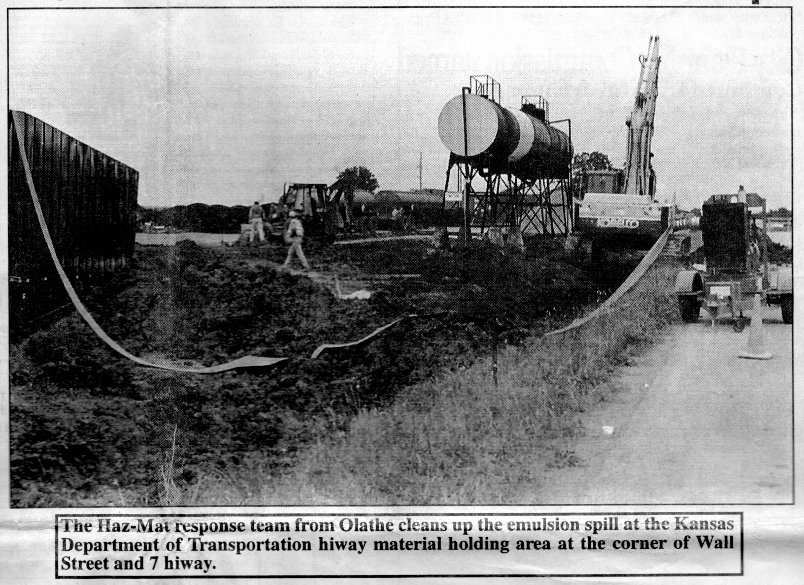
Mound City--The largest environmental hazard of the year for Linn County occurred last Thursday at the Kansas Department of Transportation Highway material holding area located at the corner of Wall Street Road and 7 Highway when a container holding slow set asphalt emulsion was either left open or opened by vandals.
An undetermined amount of the substance contaminated the area by flowing into the ditch and into a local landowners pond.
A local resident was passing the area when he noticed the emulsion running from under the tanks. He drove to the KDOT station and informed a worker of the problem. The worker then went out and turned off the valve.
On Friday morning KDOT called KDHE and surveyed the scene. They soon decided Linn County Emergency Management had to be notified due to the substance being on a county right of way. Kathleen Horttor, Emergency Management Coordinator went out to the scene to assess damages. She perceived the emulsion to be a definite threat to the Mound City water supply and felt it necessary to call in a Hazardous Materials team from Olathe who has the man power, experience and equipment to handle a situation of this magnitude.
The Haz-Mat team arrived Friday evening and worked through the weekend, twenty-four hours a day to pump the contaminant out of the pond. At this time it was believed the pond could be drained, and the contaminated soil moved out of the area. Unfortunately Sunday evening this area experienced heavy rain fall that filled the pond, which had been pumped down to less than four feet, back up to the brim.
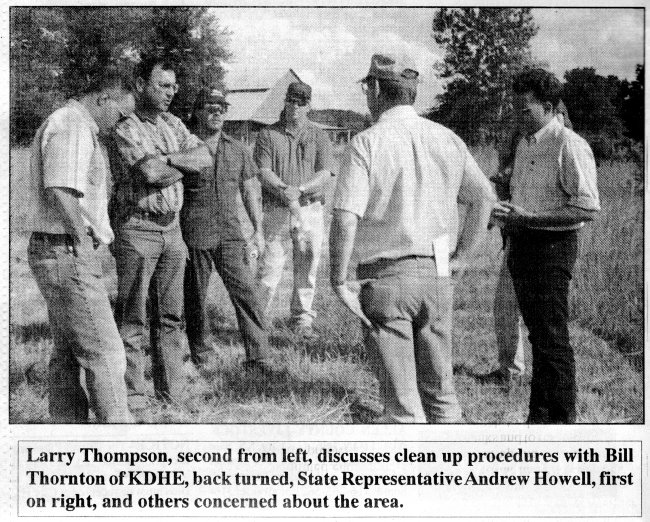
Monday morning KDHE sent Bill Thornton to discuss remediation. His opinion was that Haz-Mat was handling the clean up of the area underneath the tanks, and that the material in the pond was diluted enough not to pose a health problem to people or livestock.
State Representative Andrew Howell was present and voiced his concern for water quality and environmental impact. He questioned Thornton on samples. Thornton agreed to send the samples taken by Haz-Mat to a lab and have them analyzed. Horttor requested a letter stating the state's position on the area.
Tuesday morning a higher official, David Stuts arrived to look at the scene after receiving phone calls from a state representative and a state senator stating their concern about the situation in Linn County. Stuts assured Horttor, and others concerned that the samples would be a top priority, and sent to a state certified lab for analysis. He and Larry Thompson confirmed the types of test which would be run.
Haz-Mat had all ready begun to clean up the area underneath the tanks and to reroute the drainage ditch to drain potential rain water away from the contaminated area, and to confine the contamination to a specific place.
Contaminated water will be caught in a plastic lined catch pond dug into the ground and immediately pumped into a frac truck.
It is unknown at this time how long Haz-Mat will be needed to clean up this contaminant. Test results will be back in approximately six days and will be sent directly to Haz-Mat, Horttor and Representative Howell, at his request. The extent of more clean up will be determined at that time.
(From the Osawatomie Graphic, June 19, 1997, Page 13-A)
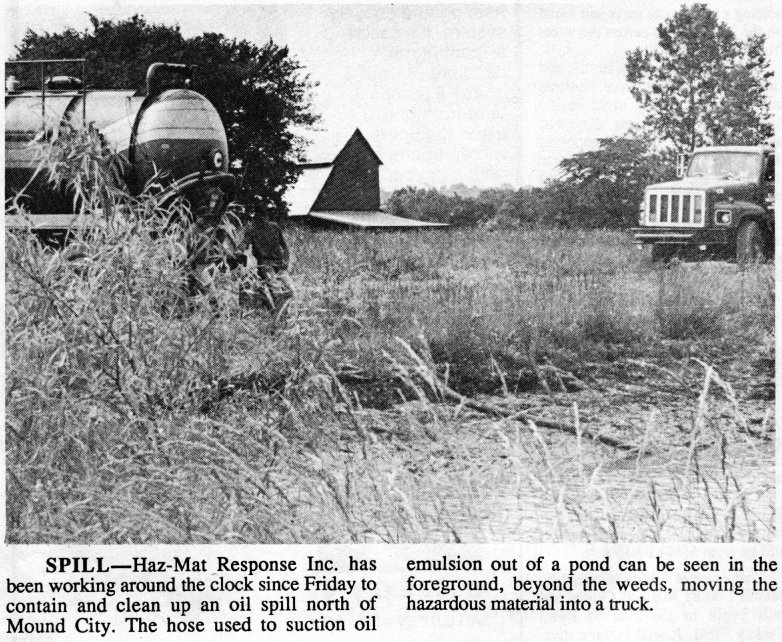
MOUND CITY - "Better safe than sorry," was the comment of Mike Stringer, Kansas Department of Transportion area engineer from Garnett. He was referring to the large scale effort to contain and clean up an oil emulsion spill which occurred Thursday, a mile north of Mound City.
After investigation by KDOT, Kansas Department of Health and Environment and Kansas Department of Wildlife and Parks, it was determined there was no toxic risk to local water sources. Water and ground samples have been taken. They have not yet been tested because there are no levels set by the state or the Environmental Protection Agency, according to Bill Thorton, environmental geologist with KDHE. Toxicity "is not an issue for the city," he said.
ALTHOUGH the liquid is a "non-regulated substance," Thorton said, Kathleen Horttor, Linn County emergency preparedness coordinator, questioned discrepancies in the chemist's report. She suggested the substance may contain 4 percent diesel fuel. Ground and water samples have been taken, but not tested, as the substance is not considered toxic. Several fish were killed due to a problem with dissolved oxygen, but only in the concentrated area just west of the spill. Fish in the pond were tested and found to be responding normally in the diluted liquid.
The problem was discovered Thursday night, when a passing notorist noticed a stream of liquid seeping from a large storage container at the Kansas Department of Transportation mixing station and storage area at the junction of Kansas Highway 7 and County Road 554. A local KDOT employee was notified, and the valve at the base of the storage tank was tightened. Area KDOT engineers were apprised of the situation, and Haz-Mat Response Inc. of Olathe was called to the scene to begin containment and cleanup.
EARLIER THAT day, 6,190 gallons of hot SS1H, an asphalt emulsion, was delivered. The tank was used last fall, but emptied on gravel roads as a dust deterrent, and as a stabilizer for hay applied for erosion control. The emulsion is used primarily in the summer months, and the tanks are routinely emptied each fall. Stringer speculated that the valve may have been closed tightly with old oil material, but that the addition of a hot substance loosened the valve, and allowed the liquid to trickle out.
Stringer said the tank is being emptied to determine how much remains in it. This will help determine the volume of the spill. Information as of Monday indicated between 100 and 200 gallons of SS1H were lost. The fluid ran into a ditch, through a culvert on Little Sugar Creek, and into a pond only 40 feet downstream for the water intake for Mound City.
THE POND was drained Friday to a depth of 3 feet, but recent rains during the weekend refilled the pond. Thorton said the additional water will dilute and dissipate the emulsion material. Two vacuum trucks were used to empty the pond, and 17 tanks were brought to the site to hold the contaminated water.
State Rep. Andrew Howell visited the site Monday, and asked about effects on the water source for the city. The cost of cleanup will be covered by KDOT, and no estimates were available early this week.
(From the Linn County News, Volume 25, Number 15, June 26, 1997, Page 1)
By Lara W. Menz
Mound City--After several executive sessions, with no warning to those involved, and with no explanation of their actions the Linn County Commission unanimously approved a motion made by Commissioner Read, and seconded by Commissioner Trask to combine the Emergency Management Department with the Rural Fire Department.
After questioning by the press the Commission revealed that a full time and a part time position had been eliminated effective immediately.
It was later learned that these positions belonged to Kathleen Horttor, who brought Linn County into compliance with Federal and State regulations, enabling the county to receive aide in the event of an emergency; and Irma Thompson, her assistant whose salary was paid for with grant money the department received.
In other matters the Commission:
..........
*Long also discussed the "little bit of spill" created by the leaking KDOT tank. KDOT wishes to use the water pumped out of the pond to wet down the roads in the county. Commissioner Mooney questioned if the material was safe. Long felt it was not a hazard as long as it did not get into drinking water supplies.
(From the Linn County News, Volume 25, Number 16, July 3, 1997, Page 1)
By Lara W. Menz
Does anybody out there remember the little spill at the Kansas Department of Transportion highway material holding area that occurred in the middle of June? Well, the results of the laboratory tests are in.
The spill, which occurred on June 12th released a quantity of road oil into a creek which empties into a pond a short distance from Little Sugar Creek. This material commonly used on roads for chipping and sealing, and paving is manufactured by Koch Industries in Wichita. According to Koch the components of the material are what remains after gasoline, diesel fuel, oils and other petroleum products are distilled from crude oil. When applied to roads it is safe, but as with any chemical misuse can result in problems. Spillage into a water supply is one such problem.
Many chemicals compose this material. This is what emergency responders were concerned about. Efforts to prevent the material from entering a county water supply were taken by Kansas Department of Transportation with input from Kathleen Horttor, former Emergency Preparedness Director. Several water samples were collected to determine what harmful chemicals might be present and sent to a state certified laboratory for testing. These samples were collected after most of the affected water had been removed from the pond and the ditch leading to it. Two main worrisome chemicals were found. One, Total Petroleum Hydrocarbons (TPH) was found in levels of 4,380 parts per million (ppm) north of Wall Street Road, 288 ppm in the creek leading to the pond and 13 ppm in the pond. No set level of safety has been set for TPH, however, a generally acceptable level of TPH is less than 100 ppm.
So how much oil was originally spilled? No one can be certain, but experts cleaning up the materials have estimated the amount to be somewhere between 3,000 and 4,000 gallons.
After a heavy rainfall on the evening of Saturday, June 14th levels of the chemical in the pond and creek dropped to less than 1 ppm due to the tens of thousands of gallons of rain water runoff. Much more than a fire department could ever provide.
The value in Little Sugar Creek also dropped to less than 1 ppm. The disturbing fact in this statistic is that it indicated that some of the contaminant did reach Little Sugar Creek, a county water supply.
Other dangerous chemicals were also detected in the pond water. They were of the class Polycyclicaromatic Hydrocarbons (PAH). One of the chemicals in this class, Benzo(a)pyrene was found in a concentration of up to 5.8 parts per billion (PPB). Benzo(a)pyrene's safe level is listed at 2 ppb.
According to a spokesman for the Emergency Planning and Response Branch of the Environmental Protection Agency (EPA) this particular chemical does not readily degrade in the environment, and is rarely detected in water analysis involving drinking water.
Benzo(a)pyrene has been studied extensively and can cause many bad health effects. It has been shown to cause still births, male and female reproductive defects and birth defects. It is classified by the National Toxicology Program as an "Anticipated Human Carcinogen", and classified by the International Agency for Research on Cancer as a carcinogen known to cause cancer in animals and is a probable human carcinogen.
To put things in perspective, chemicals are all around us, especially in a farming community. Benzo(a)pyrene can be found in cigarette smoke and charcoal grilled meats at a concentration hundreds of thousands of times lower than that acceptable in drinking water. If you eat a piece of meat from livestock treated for internal parasites, or vegetables treated with insecticides, or breath inside you home you are exposing yourself to chemicals. Extremely low doses do not cause problem, Mother Nature has equipped our bodies to handle these.
The response to prevent these materials from reaching a drinking supply was a necessary response that this reporter is appreciative of. The data from the water samples shows that if nothing had been done the people drinking from that water supply would have been drinking water with these chemicals in it.
If it were not for the removal of the contamination, the total amount of chemical would have washed into the water supply. Would the contaminant have been diluted enough in the water in Little Sugar Creek to be at safe levels? Once again, nobody knows. As the mother of a small child I for one, am happy we, as a county, did not have to find out. I appreciate the actions taken by all involved to clean the area out before it became a problem.